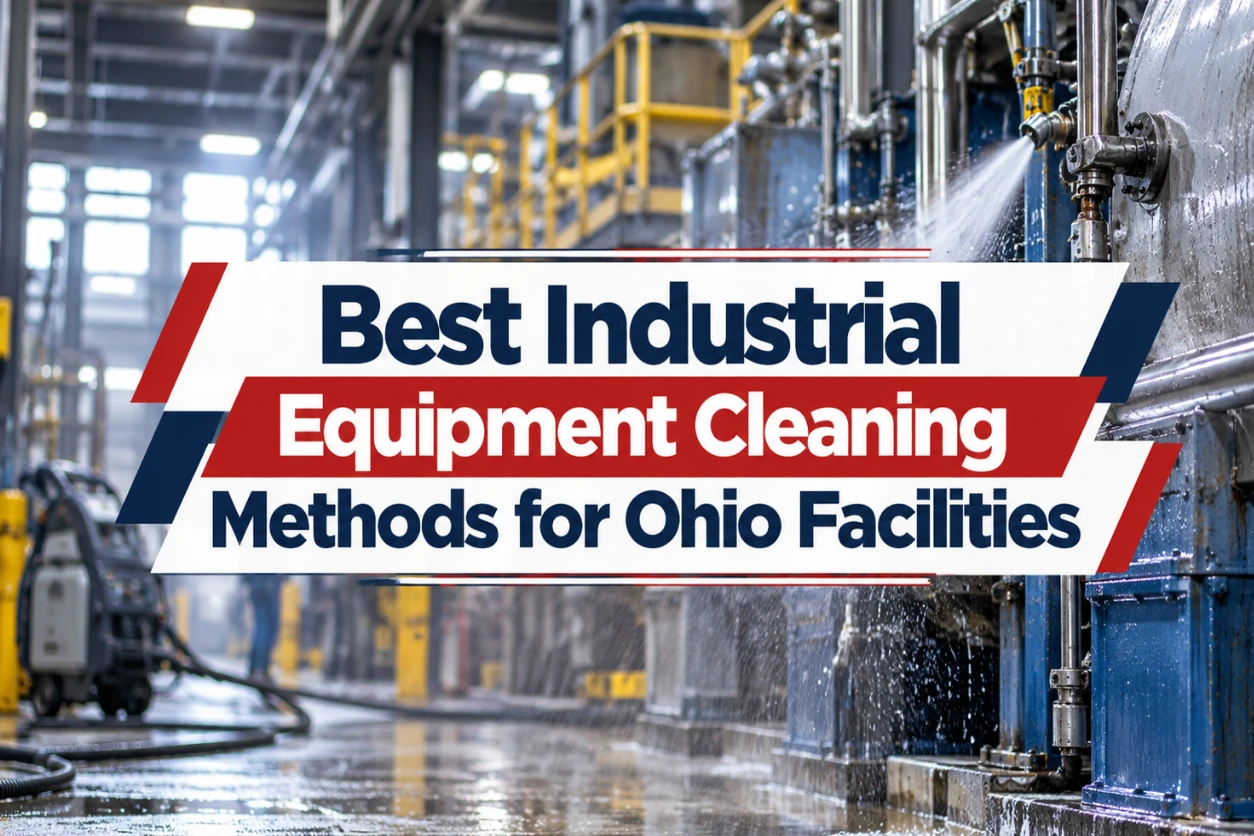
Industrial equipment rarely stays clean for long. Grease builds up around moving components, dust settles inside production areas, overspray sticks to machinery, and residue can collect in places that are difficult to reach during normal operations.
At first, that buildup may seem like little more than a housekeeping issue. Over time, however, contamination can make inspections more difficult, hide developing problems, interfere with maintenance work, and create an unnecessarily dirty work environment.
That is why industrial equipment cleaning should be considered part of a facility’s maintenance strategy rather than something that only happens when machinery becomes visibly dirty.
For manufacturing facilities in Ohio, the right cleaning method depends heavily on the equipment, contaminants, production environment, and available downtime. There is no single process that works for every machine.
Why Industrial Equipment Cleaning Matters
Production equipment is expected to operate day after day under demanding conditions. Depending on the facility, machinery may be exposed to oils, grease, metal dust, adhesives, paint, food residue, carbon buildup, dirt, or other production byproducts.
Allowing those materials to accumulate can make routine inspections and maintenance more difficult.
For example, a thick coating of grease may conceal a leaking fitting. Heavy buildup around a motor or mechanical component can make it harder for technicians to evaluate its condition. Dirt and production debris may also make maintenance work slower because technicians must clean the area before repairs can even begin.
Cleaning therefore works best when it is integrated with a broader industrial maintenance program instead of being treated as an isolated task.
A clean machine is simply easier to inspect, maintain, repair, and monitor.
Choosing the Right Industrial Equipment Cleaning Method
The biggest mistake facilities can make is assuming that stronger cleaning automatically means better cleaning.
It does not.
An aggressive process used on sensitive electrical components could create problems. Too much water around certain production machinery may be inappropriate. Harsh chemicals may not be suitable for every facility or surface.
The right method should remove the contaminant without unnecessarily damaging equipment, coatings, electrical components, or surrounding areas.
For that reason, industrial equipment cleaning usually starts with three questions: What needs to be removed? What surface is underneath it? And how much downtime is available?
Dry Ice Blasting for Industrial Equipment
For many industrial applications, dry ice blasting is worth considering because it uses compressed air and dry ice pellets to remove contamination from surfaces.
The pellets strike the surface and then sublimate, meaning the dry ice changes directly from solid carbon dioxide into gas. Because the media does not remain behind as water or abrasive blasting material, cleanup requirements can be different from traditional blasting methods.
Five Star already has a detailed explanation of how dry ice blasting works for facilities that want to understand the process in greater detail. Pasted markdown
Dry ice blasting may be useful for removing substances such as grease, oil, adhesives, production residue, carbon buildup, and certain coatings depending on the equipment and application.
It can also be attractive when facilities want to limit secondary cleaning media around machinery.
For a deeper look at industrial applications, see our complete guide to industrial dry ice blasting in Ohio. Pasted markdown
Degreasing and Manual Equipment Cleaning
Not every piece of industrial equipment requires specialized blasting.
Traditional degreasers, wipes, brushes, scraping tools, and controlled manual cleaning still play an important role in manufacturing environments.
These methods can work particularly well for localized areas where contamination is accessible, and the cleaning scope is relatively small.
Manual cleaning also gives technicians a high level of control. They can focus on specific components instead of exposing an entire machine to the cleaning process.
The disadvantage is labor. Cleaning large machinery by hand can become time-consuming, especially when grease and residue have accumulated over months or years.
That is one reason facilities should avoid waiting until equipment becomes heavily contaminated. Including cleaning within preventive factory equipment maintenance can help keep build up more manageable. Pasted markdown
Pressure Washing and Water-Based Cleaning
Pressure washing can be effective for certain industrial surfaces, equipment exteriors, floors, walls, and areas where water can be safely controlled.
However, it is not appropriate everywhere.
Electrical components, control panels, motors, bearings, sensors, and other sensitive equipment require additional consideration before water-based cleaning is used.
Facilities also need to think about wastewater. Oil, grease, chemicals, and production residue removed during cleaning may need to be contained and handled appropriately rather than simply washed across the facility.
That makes planning just as important as cleaning power.
Cleaning Equipment During Planned Shutdowns
Some of the best opportunities for deeper industrial equipment cleaning happen during planned shutdowns.
When production is already stopped for maintenance, technicians may have better access to equipment that cannot normally be cleaned while operating.
Cleaning can also be coordinated with inspections, repairs, painting, mechanical work, and other maintenance tasks.
For facilities planning outages, combining equipment cleaning with industrial shutdown and outage services can reduce the need to create another separate interruption later. Pasted markdown
This is especially useful for equipment in continuously operating production environments.
Industrial Equipment Cleaning in Food Manufacturing Facilities
Food manufacturing creates another level of complexity.
Evaluate cleaning methods not only for effectiveness but also for the production environment in which they are used.
Residue, moisture, cleaning products, and contamination control can all matter.
Industrial maintenance teams working around food production areas should understand the facility’s procedures and cleaning requirements before beginning work.
Facilities in this sector may also want to review our guide to maintenance requirements for food-grade facilities in Ohio. Pasted markdown
Cleaning Can Make Other Maintenance Work More Effective
Equipment cleaning is often not the final task. It may actually be the first step in a larger maintenance project.
Once grease, rust, residue, and contaminants are removed, crews can better evaluate the condition of the underlying surface.
Cleaning may therefore be performed before inspections, repairs, coating work, or repainting.
If equipment needs additional surface protection afterward, industrial painting for equipment protection may become part of the maintenance plan. Pasted markdown
The cleaner surface allows the maintenance team to see what they are actually working with rather than trying to evaluate equipment through layers of contamination.
How Often Should Industrial Equipment Be Cleaned?
There is no universal cleaning schedule for every manufacturing plant.
A machine operating in a dusty environment may require attention much sooner than equipment inside a relatively clean production area. Machinery exposed to oil, grease, overspray, food residue, or continuous production debris may also need more frequent cleaning.
Instead of choosing an arbitrary schedule, facilities should base cleaning frequency on operating conditions, manufacturer recommendations, inspection results, contamination levels, and maintenance history.
The goal is not to make every machine look brand new every week. It is to prevent buildup from becoming a maintenance obstacle.
This approach also supports overall industrial equipment reliability by keeping cleaning, inspection, and preventive maintenance connected rather than treating them as unrelated activities. Pasted markdown
Choosing an Industrial Equipment Cleaning Contractor in Ohio
Before hiring a contractor, explain exactly what equipment needs cleaning, what type of contamination is present, whether production will remain active, and how much downtime is available.
A contractor should be able to evaluate those conditions and recommend an appropriate process rather than automatically applying the same method to every machine.
The contractor should also understand how the cleaning work fits with the rest of the facility’s maintenance schedule.
For plants that need broader support beyond cleaning, working with an experienced industrial maintenance contractor can make it easier to coordinate cleaning, repairs, painting, facility improvements, and shutdown work under a more organized maintenance plan. Pasted markdown
Keep Industrial Equipment Cleaner and Easier to Maintain
Industrial equipment cleaning does more than improve appearance.
The right cleaning process can give maintenance teams better access to equipment, make inspections easier, prepare surfaces for additional work, and prevent years of contamination from becoming a larger problem.
The key is choosing the method that fits the equipment and facility.
Five Star Maintenance & Construction provides industrial maintenance and dry ice blasting services for manufacturing and industrial facilities throughout Northwest Ohio. If your facility has machinery, production equipment, or industrial surfaces that need professional cleaning, contact our team at 419-443-0414 to discuss the project and determine an appropriate cleaning approach.